

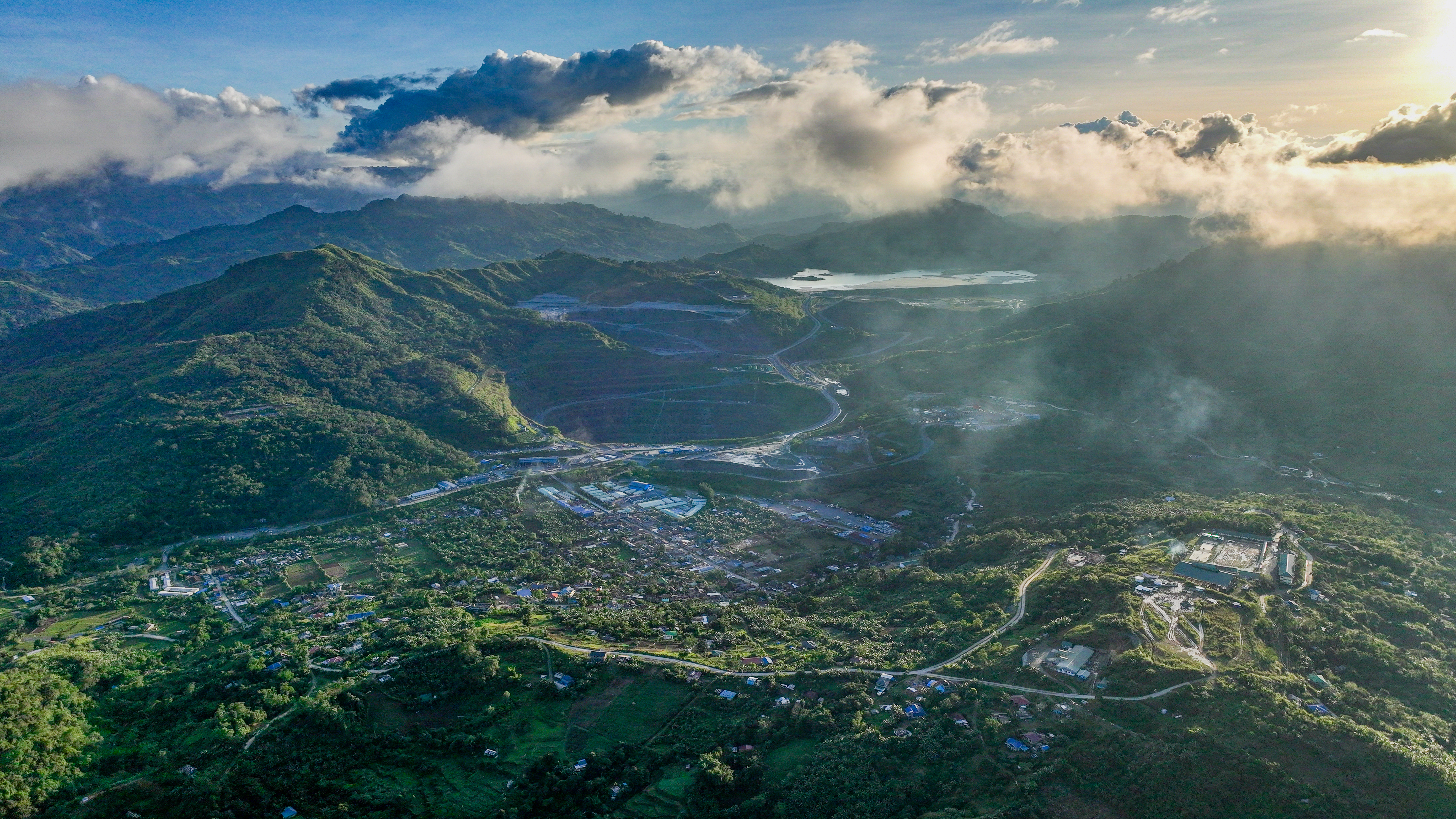
Source: OceanaGold - Didipio Mine aerial view
Source: OceanaGold - Didipio Mine panorama view
The Didipio Mine, located in the host community of Barangay Didipio, operates in 334 hectares of land, representing 34% of its Partial Declaration of Mining Feasibility (PDMF) area.
Construction of the Didipio operation commenced in June 2011 and was completed in December 2012, with official commercial open pit production declared in April 2013. The open pit was completed in April 2017.
Underground development commenced in April 2015 via a portal within the open pit, with first stoping commencing in December 2017. In July 2019, operations at the project were suspended for a period of approximately two years following the expiry of the initial 25-year term of the Didipio Financial or Technical Assistance Agreement (“FTAA”). The FTAA’s renewal for another 25 years was confirmed in July 2021, and the operation was re-started shortly thereafter.
Underground stoping will continue to employ Long Hole Open Stoping (“LHOS”) with paste fill at a mining rate of 1.9Mtpa, with the mill feed supplemented by surface stockpiles to achieve a combined processing rate of 4.0Mtpa.
Through automation, digital and process transformation, the Didipio Mine is a model of a modern operation delivering greater safety, higher efficiencies, and increased productivity. We employ surface remote bogging, which aims to increase the stope production rate and enhance safety by removing personnel from hazardous areas, and digitised task management, aimed at increasing equipment utilisation and efficiency. Personal safety beacons monitor mine employees’ locations in real-time, enabling rapid accounting for personnel in emergencies. A fibre optic backbone and Wi-Fi-based network, meanwhile, enables these underground mining technologies.
Recovery of copper and gold at Didipio is achieved from the use of froth flotation following a conventional SAG Mill-Ball Mill pebble crushing grinding circuit and gravity gold recovery circuit. The plant has successfully ran for nine years running.
Annual production is forecast to be 100-130 koz of gold per annum from 2022 until 2027 when grades start to decline. Similarly, annual copper production is forecast to be 12-13kt from 2022 until 2029, dropping to below 10kt from 2030 onwards.
The mill has achieved targeted utilisation rates greater than 95% when required and processed the permitted 4.0Mt of ore annually. Copper and gold recovery rates have been in line with forecast rates used in the production planning process.
Infrastructure includes a tailings storage facility, workshops, camp, water treatment plant, paste fill plant and ore processing facilities. The Didipio Mine’s paste fill plant is the Philippines’ first fully automated plant, which reduces the TSF capacity requirement. It is also a ground support strategy for regional stability as it ensures that no large-scale underground void is left after ore extraction.
The project’s power supply is through its connection to the national grid via a 69kV dedicated line to Bayombong, allowing the diesel generators on site to be used as a backup only reducing the cost of electricity appreciably.
The tailings storage facility has been designed to accommodate the life of mine tailings requirement net of paste backfill. The current construction schedule supports the filling schedule, with most of the dam core constructed during open pit mining.